Mike Kojima posted on December 29, 2008 04:00

The main differences between the 350Z and the 370Z's rear suspension geometry are that the 370Z has a shorter radius rod that is closer to being parallel to the ground. The 350Z's radius rod is tilting upward toward the front of the car at a greater angle. The 370Z's upper control arm is also very close to parallel to the ground where the 350Z's is pointing downward towards the front of the car. The effect of this is a reduction of anti-squat geometry and the shorter radius rod will translate through a tighter arc giving the suspension little bit of passive toe-in under roll.
 |
|
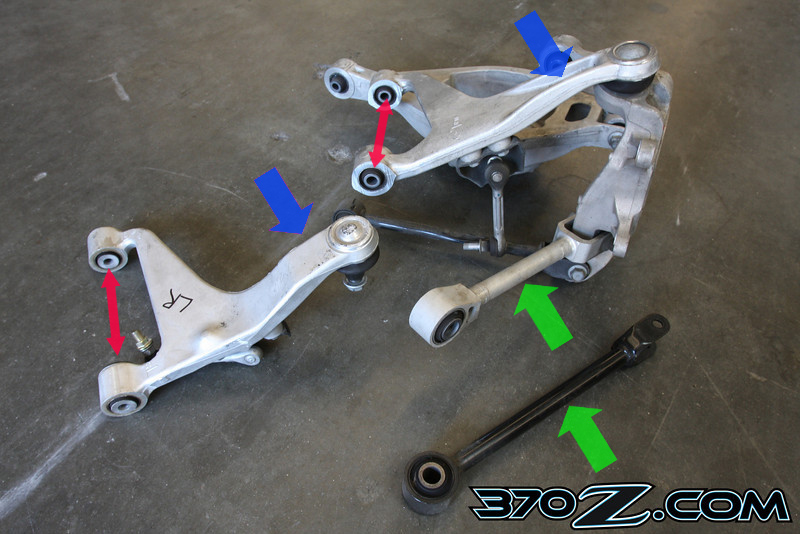
The main differences in suspension geometry between the 350Z and 370Z’s rear suspension are shown here in a different view with the parts off of the car. The radius rods are shown by the green arrows. The silver aluminum 370 rod is shorter and mounted more parallel to the ground. The longer black steel 350Z part is tilted upward toward the front of the car more. The 370Z and 350Z's upper control arms mounting axis’s are shown by the red arrows. The 370Z's axis is more parallel to the ground due to the forward mount being raised. The relocation of the pivots reduces anti squat in the suspension geometry and the shorter radius rod give passive toe in under roll for more stability. The blue arrows show how Nissan made the 370Z's suspension parts lighter and stronger. In this area the 350Z part is thick and solid. Notice the same area on the 370Z is thinner but has vertical ribs forged in place for stiffness and strength in the direction of load.
|
Less antisquat in the suspension geometry will bind the suspension less during torque transmittal under acceleration or braking. A freer to move rear suspension will give the rear tires more grip on corner exit and a more linear relationship of weight transfer to throttle opening. This is useful for throttle steering, better off the line traction and less propensity to wheel hop under hard acceleration and braking.
Passive toe-in under cornering load induced body roll makes the car more stable when applying the throttle out of a corner and reduces trailing throttle oversteer. Less antisquat means more wheel rate through stiffer springs or shock valving tricks is needed to control on throttle squat. We feel that the rear geometry changes Nissan made are all for the better as our experience racing the 350Z has shown that it is hard to get the 350Z to come off the corners well. Nissan probably realized that the 350Z had the problems as well and worked to correct them in the 370Z. A little known secret is that the M35/45/G37 rear suspension, steel subframe and all bolts to the 350 with only a 15 lb weight penalty so we would not be too surprised if the 370's rear end does the same.